
“We are what we pretend to be, so we must be very careful about what we pretend to be.”
I suppose that when people hear the name Kurt Vonnegut, books like Slaughterhouse-Five and Cat’s Cradle come to mind. There isn’t really a problem with that — those are both great books.
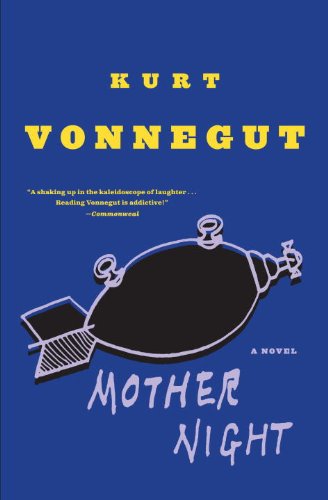
Vonnegut wrote a lot of books, but there is one in particular that I don’t often see mentioned in Vonnegut discussions and that is Mother Night. First published in 1962, the book talks about Howard W. Campbell Jr., who also makes a brief appearance in Slaughterhouse-Five. Campbell is an infamous Nazi propagandist who broadcasted pro-Nazi lectures over the radio during WWII. He’s now awaiting execution in Isreal for his war crimes. Except, he was never really a Nazi. He was actually an American spy tasked with sending strategic messages secretly through his lectures.
There’s a hell of a funny bit (or harrowing bit — you know how Vonnegut likes to blend the dark side of humanity with comedy) when Campbell sends a broadcast but, unbeknownst to him, he’s actually telling his Ally supervisor that his wife has died. He literally announces the death of his wife without knowing it. It’s a hell of a moment in the book.
Vonnegut said that this book is his most moral book. This guy, Campbell, he’s not Nazi — he’s just pretending, right? Well, Vonnegut says no — by pretending to be a Nazi, Campbell becomes one.
There’s a definition of Tragedy that I think is good to mention here. Tragedy may be understood as when two characters, both of whom are right, come into conflict. It is easy to say that truth trumps falsity. But what happens when truth faces off against truth? That is exactly what happens in this novel. It’s a disturbing ethical exercise.
I would not have picked up Mother Night had I not seen a suggested video on my YouTube feed in which Vonnegut discusses the book. I have no regrets. I can easily say this is my favorite Vonnegut work,
You ought to read it.

 a young writer from the lone star state